
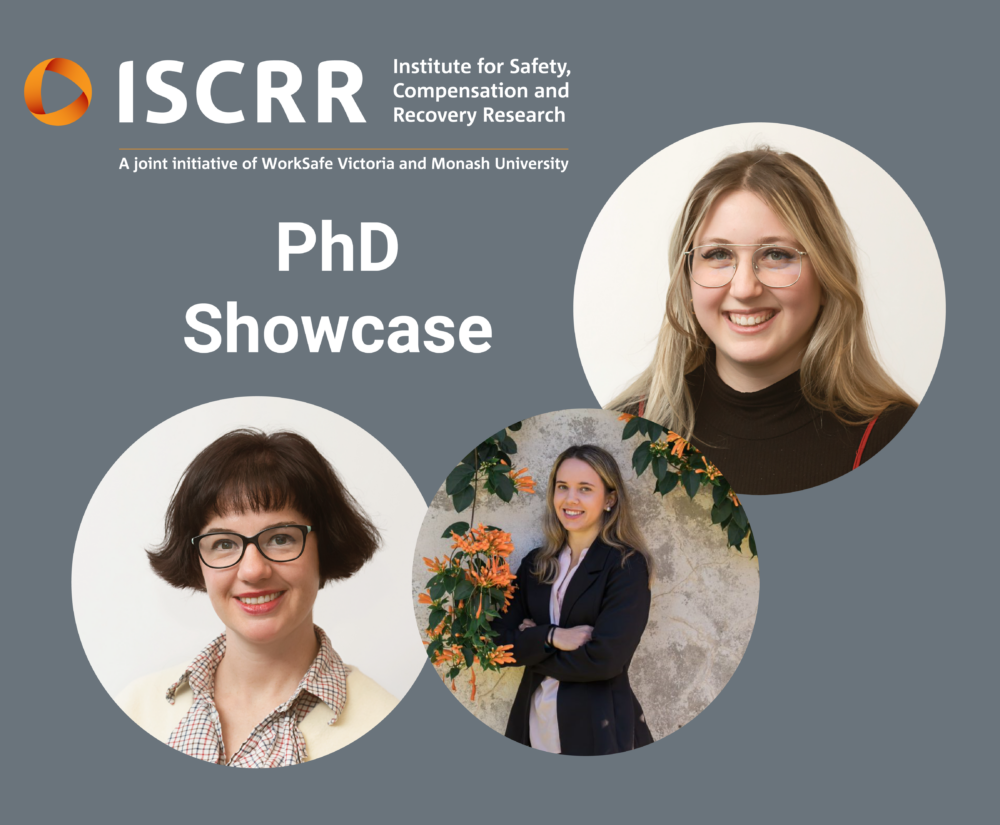
ISCRR is proud to supervise three PhD students doing excellent research in the field of work, health, compensation and safety. Here is a showcase of what each of them have uncovered so far on their doctorate journeys!

Edwina Sekine is halfway through her PhD research into investigating the relationship between injury compensation systems and recovery outcomes in people with Functional Neurological Disorder (FND).
FND describes a neuropsychiatric condition in which neurological symptoms cannot be explained by a medical condition. The symptoms are real and can be very distressing and functionally impactful for the person with the condition. The focus of this research are people whose FND onset was experienced following an injury. Currently, the mechanism by which this occurs is not fully understood, but psychosocial stressors have been implicated.
So far Edwina has published a systematic review of the biopsychosocial factors impacting recovery for people with FND, and found that the strongest predictor of outcomes was participation in work.
She has interviewed a number of people with FND using photo-elicitation methods, an approach that provides particularly vulnerable interviewees with greater agency to tell their stories.
While she is nearing completion of this aspect of her thesis, she is securing data from compensation systems to be able to investigate what return to work outcomes look like for people with FND who are making a claim for either a work or road-related injury.
Edwina is jointly supervised by Dr Janine McMillan, Dr Sarah Oxford and Associate Professor Ross Iles at ISCRR.

Olivia Crivari currently works as a Research Fellow at ISCRR for two days a week, and pursues her PhD research for the remainder of the week.
Supervised by Associate Professor Carlyn Muir and Dr Jason Kearney from MUARC, and Professor Sarah Anderson from ISCRR, Olivia’s research examines the relationship between safety and retention for female firefighters in Australia, with a focus on how physical and psychological injuries influence return to work and long-term career outcomes.
So far, Olivia has completed a systematic review, and designed and begun her first study: interviewing senior female firefighters in Australia about their historical experience. She is currently in the process of interviewing study participants and will conduct a critical discourse analysis of the results.

Edwina Liszewski is jointly supervised by ISCRR’s Dr Sarah Oxford and MUARC’s Professor Jennie Oxley. Edwina is investigating what makes leader-led safety programs effective and sustainable in the workplace.
Her research focuses on understanding how these programs have been implemented across high-income, industrialised countries, with a particular interest in how they have been adopted, adapted and translated across different Australian industries. Through a combination of international evidence and qualitative research with Australian workplaces, Edwina aims to identify the key elements that contribute to meaningful and lasting improvements in workplace safety.
The research will explore the safety outcomes associated with leader-led safety programs, including stronger safety cultures, improved relationships between workers and leaders, better safety training outcomes, reduced operational conflict, and improvements in both leading and lagging safety indicators.
Currently completing a scoping review and preparing for the qualitative phase of her research, Edwina is passionate about ensuring safety programs are thoughtfully implemented—not simply copied from one organisation to another—so they create lasting, positive change for workers and organisations alike.